You've probably heard the term RAG thrown around in AI conversations. Maybe an agency mentioned it in a pitch. Maybe you saw it on a product page. The name is technical, but the concept is straightforward, and understanding it will help you make better decisions about AI for your business.
The problem RAG solves
Standard AI models like ChatGPT know a lot about the world, but they know nothing about your business. Ask ChatGPT about your return policy, your product specs, or your office hours and it will either make something up or tell you it doesn't know.
That's a problem if you want AI to answer customer questions, support your sales team, or help employees find internal information. The AI needs access to your specific data to be useful.
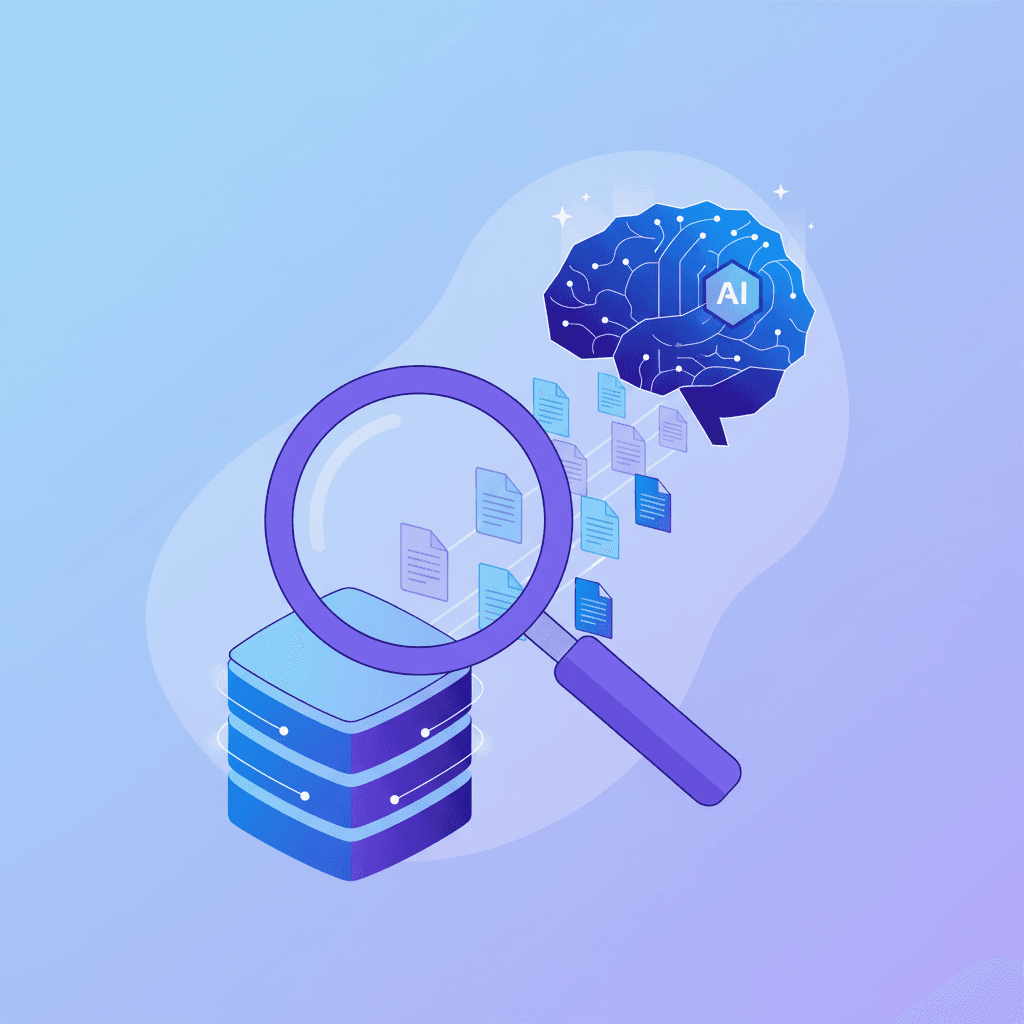
RAG solves this by connecting the AI to your documents, databases, and knowledge bases at the moment it generates a response. Instead of relying only on what it learned during training, the AI retrieves relevant information from your data first, then uses that information to write an accurate answer.
How it works (simply)
Think of it in three steps:
- Someone asks a question. A customer types "What's your return policy for opened items?" into your chatbot.
- The system searches your data. RAG looks through your documents, your policy pages, your FAQ database, and finds the relevant sections about returns for opened items.
- The AI writes an answer using that data. Instead of guessing, the AI has the actual policy text in front of it. It writes a clear, accurate response based on what your documents actually say.
The "retrieval" part is the search. The "augmented generation" part is the AI writing a response with that retrieved context. Together, you get answers grounded in your real business information.
What business data can RAG use?
Almost anything text-based:
- Product catalogs and spec sheets
- Policy documents (returns, shipping, warranties)
- Employee handbooks and SOPs
- FAQ pages and support articles
- Sales proposals and pricing sheets
- Meeting notes and internal memos
- Technical documentation
The more relevant data you connect, the more useful the system becomes. Most RAG implementations start with customer-facing content like FAQs and product info, then expand to internal knowledge bases over time.
Why RAG beats fine-tuning
You might hear about "fine-tuning" as an alternative, which involves retraining an AI model on your data. Fine-tuning has its place, but for most business use cases, RAG is the better choice.
RAG is cheaper. Fine-tuning requires significant compute resources and technical expertise. RAG works with off-the-shelf AI models and just adds a search layer on top.
RAG stays current. When your policies change or you add new products, you update the source documents and the AI immediately has the new information. With fine-tuning, you'd need to retrain the model from scratch.
RAG is more transparent. Because the system retrieves specific documents, you can see exactly where an answer came from. That makes it easier to verify accuracy and debug problems when they come up.
Real business applications
Customer support
A RAG-powered chatbot on your website can answer the vast majority of customer questions accurately because it's pulling from your actual support documentation. This handles the 80% of repetitive questions so your team can focus on complex issues that genuinely require human judgment.
Internal knowledge base
Employees spend hours searching for information across scattered documents, wikis, and email threads. A RAG system lets them ask questions in plain English and get answers sourced from your internal docs. "What's our process for handling a warranty claim over $500?" gets an accurate answer in seconds instead of a 20-minute search.
Sales enablement
Sales teams can query the system about product comparisons, pricing structures, and competitive differentiators. The AI pulls from your latest sales materials and gives reps accurate information without them having to dig through folders or wait for a colleague to respond.
Browse agencies specializing in RAG and search to find partners with experience building these systems for businesses like yours.
What it costs
RAG implementations vary widely in cost depending on scale and complexity. A basic RAG chatbot for a small business with a few hundred documents typically costs $5,000 to $15,000 to build, with ongoing costs of $200 to $500 per month for hosting and AI API usage.
More complex implementations with thousands of documents, multiple data sources, and custom integrations can run $15,000 to $50,000 or more. Even high-volume systems rarely exceed $1,000 to $2,000 per month in ongoing costs.
The ROI calculation is usually straightforward. If a RAG chatbot deflects even 30% of your support tickets or saves your sales team 5 hours per week, it typically pays for itself within 3 to 6 months.
Getting started
You don't need to understand the technical details to implement RAG. That's what agencies are for. What you do need is organized business data in digital format and clarity about what questions you want the system to answer.
Start by identifying your highest-volume, most repetitive questions, whether from customers, employees, or sales reps. Those are your best candidates for RAG automation. If you can write down the 30 questions your team answers most often, you have the foundation for a useful RAG system.
Not sure if RAG is the right approach for your business needs? Take the AgencyMatchAI quiz and describe your situation. We'll match you with agencies that specialize in the specific type of AI solution that fits your use case, whether that's RAG, chatbots, automation, or something else entirely.