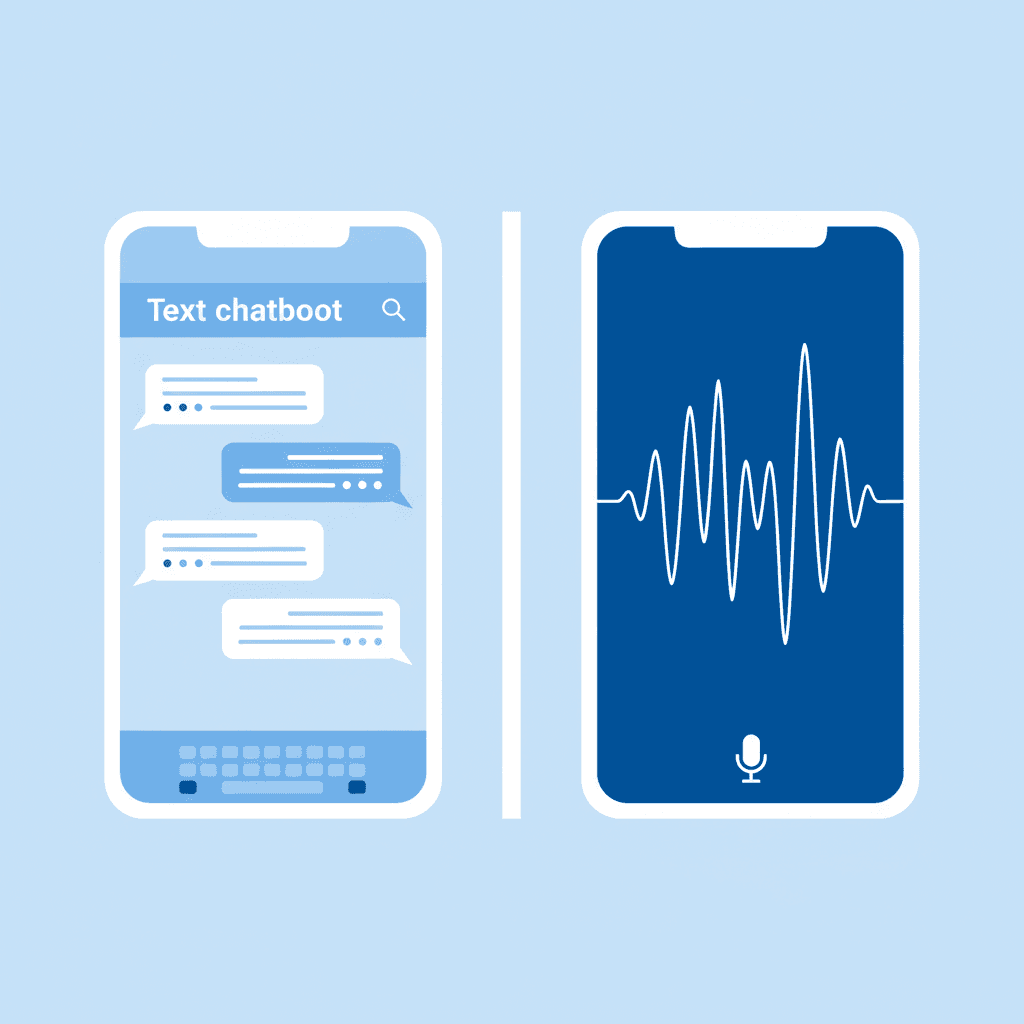
Most business owners asking "should I use a chatbot or voice AI?" are really asking a simpler question: where do my customers get stuck, and how do I fix it? The technology is secondary. Start with the friction point, and the right solution usually becomes obvious.
That said, text chatbots and voice AI are genuinely different products. They use different infrastructure, cost different amounts to deploy, and serve different customer behaviors. Understanding those differences helps you spend your budget in the right place.
What text chatbots actually do
A text chatbot is software that has a written conversation with your customers, usually on your website, inside your app, or on a messaging platform like SMS or WhatsApp. When a customer types a question, the bot reads it, understands the intent, and replies with a relevant answer or action.
Modern AI chatbots, built on large language models, can handle surprisingly nuanced questions. They can look up order status, answer product questions, collect lead information, schedule appointments, and escalate to a human when the conversation gets complex. The best ones feel natural to talk to.
Chatbots work asynchronously. The customer types, the bot responds, and there's no expectation of instant reply in the same way a phone call demands. That flexibility makes chatbots easier to deploy and easier for customers to use at their own pace.
What voice AI actually does
Voice AI handles phone calls. A customer calls your business number, and instead of reaching a hold queue or voicemail, they reach an AI that can speak naturally, understand what they're saying, and take action on their behalf.
The core technology combines speech-to-text (converting what the caller says into text), a language model that figures out what they want, and text-to-speech that converts the AI's response back into spoken audio. The best voice AI systems are fast enough that callers often don't realize they're talking to software.
Voice AI can answer questions, take reservations, route calls to the right department, collect information before a human picks up, and handle entire call types end-to-end without any human involvement. For businesses with high call volume, this changes the economics of customer service significantly.
Head-to-head comparison
Speed and immediacy
Voice AI operates in real time. The caller speaks, and the AI must respond within a second or two, or the conversation feels broken. This creates higher technical demands but also delivers the kind of instant responsiveness customers expect from a phone call.
Chatbots have more flexibility. Responses typically arrive in under two seconds, but there's no social awkwardness if there's a brief pause. Text also lets customers re-read answers, which is an advantage for complex information.
Channel fit
Chatbots live on screens: websites, mobile apps, SMS, and social media. If your customers primarily discover and interact with you online, a chatbot meets them where they already are. Voice AI lives on phone calls. If your customers call you, that's where voice AI delivers value.
Many businesses need both. A dental practice might use a chatbot on their website to handle appointment requests after hours and voice AI to handle the phone calls that still come in during the day.
Customer comfort
Some customers strongly prefer typing. Others find it uncomfortable and would rather just call. Age, industry, and context all affect this. A tech-savvy e-commerce customer will happily chat. An older patient calling a medical office may find a chatbot frustrating but respond well to a natural-sounding voice AI.
There's also a situational element. A customer driving to your restaurant is going to call, not type. A customer browsing your products at midnight is going to use whatever's on the screen.
Cost to deploy
Text chatbots are generally less expensive to build and deploy than voice AI. A solid website chatbot for an SMB typically costs between $200 and $800 per month for a managed solution, or a one-time build from $3,000 to $15,000 from an agency. Voice AI carries higher complexity and typically starts around $500 to $1,500 per month for managed systems handling meaningful call volume.
Both are almost always cheaper than hiring additional staff to cover the same volume. That's the real comparison to make.
Use cases by industry
Restaurants and food service
Restaurants are one of the clearest voice AI use cases. Customers call to make reservations, ask about hours, check wait times, and place to-go orders. Voice AI can handle all of these without tying up your front-of-house staff. A busy restaurant can easily receive 50 to 100 calls per day, and freeing staff from the phone is an immediate operational win.
Chatbots complement this on the web side, handling online reservations and FAQ responses. Browse agencies that specialize in Voice AI if your restaurant's phone volume is the primary pain point.
Healthcare and medical offices
Medical practices have significant call volume around appointment scheduling, prescription refills, and basic triage questions. Voice AI handles these calls consistently and can route urgent calls to clinical staff immediately.
Chatbots are useful on the patient portal side, answering insurance questions, sending appointment reminders via SMS, and collecting intake information before visits.
E-commerce and retail
For online retailers, chatbots are usually the right starting point. Customers want to know order status, return policies, and product details at 2 AM when your staff isn't available. A well-built chatbot handles the long tail of support questions so your team can focus on complex issues.
Voice AI is less central here unless you also run a physical store or have a significant number of customers who prefer calling in.
Professional services (legal, financial, real estate)
Lead qualification is the primary chatbot use case for professional services. A chatbot on a law firm's website can ask qualifying questions, collect contact info, and book a consultation, all before a human ever gets involved. This saves the attorney's time for actual legal work.
Voice AI is valuable here for firms that get significant inbound call volume. A chatbot on the website plus voice AI on the phone covers both channels cleanly.
Home services (HVAC, plumbing, cleaning)
Home service businesses live and die by their phones. When someone's furnace breaks at midnight, they're calling. Voice AI can handle those after-hours calls, collect the address and problem description, and either book a service appointment or alert an on-call technician. That's pure revenue recovery that would otherwise go to a competitor who picked up.
Explore chatbot agencies if your focus is web-based lead capture, and browse voice AI specialists if you need the phone covered.
Can you use both?
Yes, and many businesses should. The channels serve different moments in the customer journey. A customer might find you through your website and book via chatbot, then call later with a question and reach your voice AI. Consistency across both channels, with the same tone, same information, and same ability to take action, creates a better overall experience.
Some platforms offer unified solutions that handle both text and voice from a single backend. This simplifies management and keeps your business knowledge in one place. When evaluating agencies, ask whether they offer multi-channel solutions if you need coverage in both areas.
According to Gartner, conversational AI is becoming a primary customer service channel across industries. Getting the right mix in place now means less catching up later.
Making the decision
Ask yourself two questions. First, where do your customers currently reach you, and where does the experience break down? Second, what's the highest-volume, most repetitive task your team handles in customer communication right now?
Your answers will point to the right starting place. If the bottleneck is your phone, start with voice AI. If it's your website or after-hours support, start with a chatbot. If it's both, look for an agency that can address both channels with a coherent approach.
Not sure which direction fits your business? Take the AgencyMatchAI quiz and get a personalized recommendation based on your industry, customer contact patterns, and budget. It takes about 3 minutes.
A Harvard Business Review analysis found that the highest ROI from AI comes when it's applied to high-volume, predictable tasks where human time is genuinely constrained. Both chatbots and voice AI fit that description in the right context. The key is matching the tool to the actual problem.