Pricing for AI chatbots is genuinely confusing right now. You'll find $49/month SaaS tools sitting next to six-figure custom builds, and vendors aren't always transparent about what separates them. This guide breaks down what you actually get at each price point — and where the hidden costs tend to show up.
Before diving in, know that a chatbot's price is almost never about the technology alone. You're paying for design, training data, integration work, and the expertise to make it useful. Two chatbots built on the same AI model can cost $8,000 and $60,000 depending on how complex the setup is. Understanding that complexity is the key to budgeting accurately.
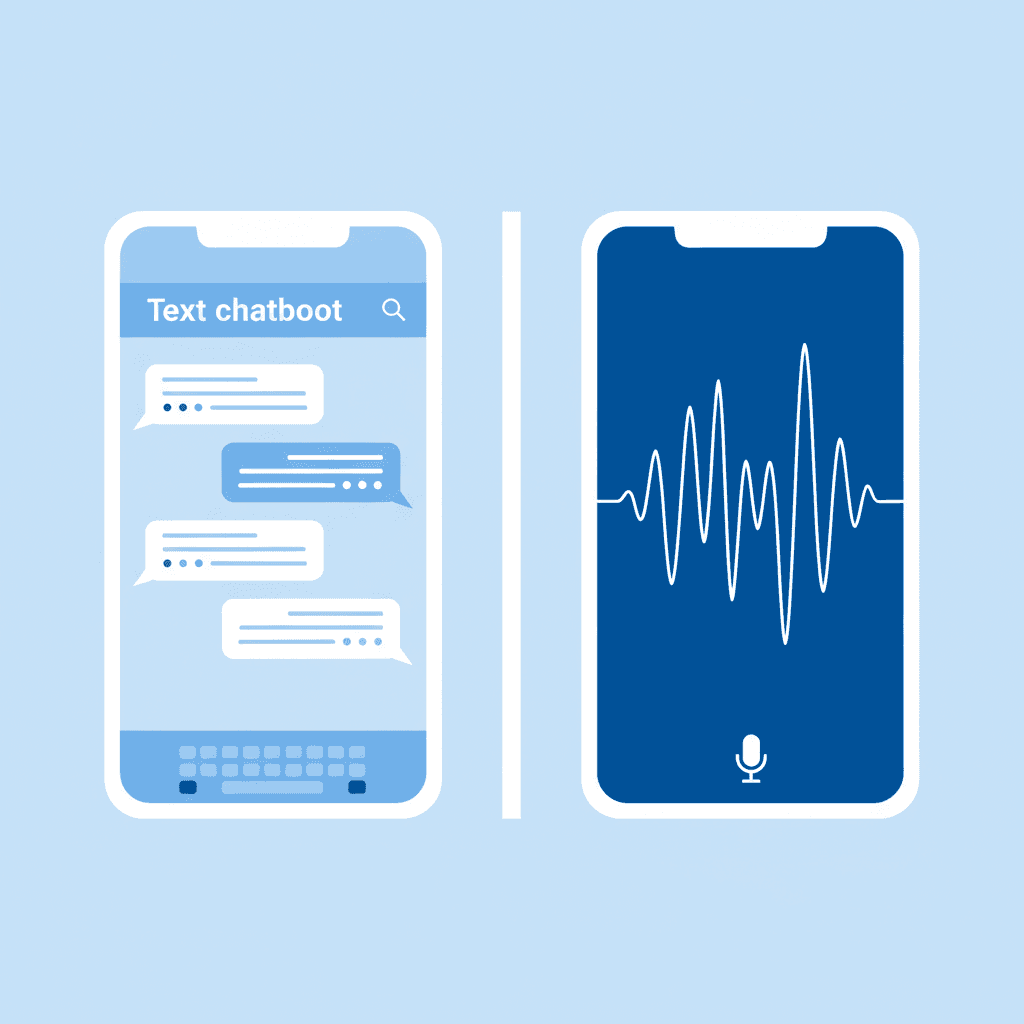
If you're trying to figure out what kind of chatbot actually fits your business before worrying about price, our AI chatbots vs. voice AI comparison is a good starting point.
The Four Tiers of AI Chatbot Builds
Tier 1: Rule-Based Chatbots, $3,000 to $10,000
Rule-based chatbots follow a decision tree. They match user inputs to predefined responses. They can't handle anything outside of what they've been explicitly programmed for, but they're reliable, predictable, and cheap to run.
This tier makes sense for narrow, well-defined use cases: booking appointments via a fixed form, answering a short FAQ list, routing leads to the right department. A dental practice using a bot to handle "schedule a cleaning" or "what insurance do you take?" doesn't need AI. A rule-based bot handles that fine at a fraction of the cost.
What you get for $3K–$10K: basic conversation flows, integration with one or two tools (usually a calendar or CRM), and a month or two of post-launch support. Don't expect nuance or flexibility.
Tier 2: AI-Powered Chatbots (GPT/Claude), $10,000 to $50,000
AI-powered chatbots use large language models, typically OpenAI's GPT-4o or Anthropic's Claude via API, to generate natural responses. Unlike rule-based bots, they handle unexpected questions, maintain conversational context, and can be trained on your specific business content.
This is where most small businesses should be looking. A well-built AI chatbot in this range can handle complex support questions, qualify leads intelligently, and escalate to a human when the situation calls for it. The bot actually understands what a customer is asking, not just pattern-matches against a keyword list.
The wide price range reflects scope. A $12,000 build might be a customer support bot with basic CRM integration. A $45,000 build might include multi-channel deployment (web, SMS, WhatsApp), deep integrations with your inventory or booking system, and custom persona development.
Tier 3: Custom-Trained AI with RAG, $25,000 to $100,000+
Retrieval-Augmented Generation (RAG) is the approach you use when the chatbot needs to answer questions from a large, specific knowledge base, your product catalog, internal documentation, legal agreements, or years of support tickets. The AI retrieves relevant information and generates accurate answers grounded in your actual data, rather than relying on general training.
This tier is appropriate for businesses with complex products, regulated industries, or high-volume support needs where accuracy matters a lot. A SaaS company, a financial services firm, or a healthcare provider might legitimately need this level of sophistication. A local retailer probably doesn't.
Costs in this range reflect the data engineering work involved: cleaning and structuring your knowledge base, building the retrieval pipeline, testing for accuracy and hallucination, and ongoing monitoring. For a deeper explanation of how this technology works, this breakdown of AI agents from Empowerment AI covers the architecture well.
Tier 4: DIY Platforms, $50/month to $500/month
Platforms like Tidio, Intercom, and Drift (now Salesloft) let you build and deploy AI chatbots without custom development. They're fast to launch, require minimal technical skill, and work well for standard use cases.
The tradeoff is customization. You're working within the platform's constraints on what the bot can do, where it can connect, and how it presents itself. For businesses with standard needs and limited budgets, a $200/month SaaS chatbot is a reasonable starting point. For businesses with specific workflows, unusual tech stacks, or a need for deep integration, platforms quickly become limiting.
The Real Pricing Comparison
| Type | Build Cost | Monthly Ongoing | Best For |
|---|---|---|---|
| Rule-based bot | $3K–$10K | $50–$200 | Simple FAQ, appointment booking |
| AI-powered (GPT/Claude) | $10K–$50K | $200–$800 | Lead gen, support, sales assist |
| Custom RAG system | $25K–$100K+ | $500–$1,500+ | Large knowledge bases, regulated industries |
| DIY platform (SaaS) | $0 setup | $50–$500/mo | Standard use cases, limited budget |
Ongoing Costs: What People Forget to Budget
The build cost is a one-time number. The ongoing costs run forever, and they catch a lot of business owners off guard.
API Fees
API fees are what you pay to the AI model provider every time your bot processes a conversation. OpenAI's pricing runs roughly $2.50–$10 per million tokens for GPT-4o, depending on input vs. output. A busy chatbot handling 1,000 conversations per day can generate meaningful monthly API bills.
A rough estimate: a small business chatbot handling 500 conversations per month might cost $30–$80/month in API fees. A high-volume site with 10,000 monthly interactions could hit $300–$600/month just in API costs. Your agency should give you a projected usage estimate before you sign.
Hosting and Infrastructure
Custom chatbots need to run somewhere. Cloud hosting on AWS, Google Cloud, or Azure typically adds $50–$300/month depending on traffic and architecture. Some agencies include hosting in a monthly retainer; others bill it separately. Clarify this before the project starts.
Maintenance and Updates
AI chatbots aren't set-and-forget. As your products change, your policies update, or the underlying AI models get new versions, your bot needs to be updated too. Most agencies offer maintenance retainers ranging from $300–$1,500/month. Without one, expect to pay hourly ($100–$200/hr) when something needs to change.
Platform-based bots (Tidio, Intercom, etc.) handle their own infrastructure, so your ongoing cost is just the subscription fee. The tradeoff is less control when you want to modify behavior.
Hidden Costs That Kill Budgets
Training Data Preparation
If you want your chatbot to answer accurately about your specific products, services, or policies, someone has to prepare that data. This means cleaning up your knowledge base, formatting documents, tagging information correctly, and testing that the bot actually uses it well. This work is time-consuming and often underestimated in initial quotes.
Plan for $1,500–$8,000 in data preparation work if you're building a RAG system. Even standard AI bots need a structured FAQ, sample conversations, and edge case testing before they're ready for real customers.
Integration Complexity
Connecting your chatbot to your CRM, helpdesk, e-commerce platform, or booking system sounds simple. It rarely is. Every integration adds development hours. A clean Shopify or HubSpot connection might take 5–10 hours. A custom integration with a niche system can balloon to 40+ hours at $100–$175/hr.
Ask your agency for a specific line item on integrations before you sign. "We'll connect it to your systems" is not a sufficient answer.
Testing and QA
AI chatbots need extensive testing before they go live. You need to verify they handle edge cases correctly, don't produce embarrassing or incorrect answers, and escalate to humans at the right moments. Budget 10–20% of the build cost for QA. Agencies that skip this step are the ones whose bots end up in viral Twitter threads for the wrong reasons.
Staff Training
Someone on your team needs to understand how to manage the bot, review conversation logs, and handle escalated chats. If the agency doesn't include training in the scope, add it. A few hours of documentation and walkthroughs can prevent months of friction.
Agency-Built vs. DIY: The Real Trade-Off
DIY platforms win on speed and simplicity. You can have a functional Tidio or Intercom bot running in a day, with no development cost. If you're a small retailer who needs basic chat support and lead capture, a $150/month platform is probably all you need.
Agency-built bots win when your requirements go beyond what platforms support: custom logic, deep integrations, branded experience, or performance requirements that SaaS tools can't meet. The $15,000 you spend on a proper custom build will outperform five years of a $200/month platform subscription if your use case is genuinely complex.
The mistake most businesses make is letting platform limitations quietly constrain what they think is possible. They build a workaround instead of asking whether a custom build would actually be cheaper over a three-year horizon. Run the math both ways. Our ROI analysis shows how to do that calculation properly.
For more on the types of automation that tend to deliver the best returns, this Empowerment AI breakdown of high-ROI automations covers where chatbots fit relative to other options.
What to Actually Ask an Agency Before You Pay
Most budget overruns come from scoping ambiguity. Before you sign anything, get written answers to these questions:
- What's included vs. billed separately? API fees, hosting, testing, training, post-launch support, know what each item costs.
- What does the monthly cost look like after launch? Get a projected range based on your expected usage volume.
- Who owns the code and the data? Some agencies build on proprietary platforms they control. If they disappear, you lose the bot. Insist on owning your own system.
- What triggers additional charges? Scope creep is the norm in software projects. Know in advance what changes cost extra.
- How is accuracy guaranteed? For AI bots especially, ask about hallucination testing, accuracy benchmarks, and what happens when the bot gives a wrong answer.
Our guide on how to choose the right AI agency goes deeper on agency vetting, including the specific red flags that separate credible shops from fly-by-night operators.
How to Budget if You're Starting From Zero
Here's a realistic framework for a small business with no existing chatbot infrastructure:
Starter budget ($5K–$15K total): You're looking at a rule-based bot or a lightweight AI chatbot on a managed platform. Suitable for appointment booking, basic FAQ, or simple lead capture. Monthly ongoing cost: $100–$300.
Mid-range budget ($15K–$40K total): This buys a properly built AI chatbot with integrations into your CRM or helpdesk, a branded experience, and meaningful support post-launch. This is the right range for most small businesses with real customer support or sales use cases. Monthly ongoing: $300–$800.
Serious investment ($40K–$100K+): Custom RAG systems, multi-channel deployment, enterprise-grade reliability. Warranted when your support volume is high, your knowledge base is complex, or accuracy is a compliance requirement. Monthly ongoing: $800–$2,000+.
If you're ready to start talking to agencies, take our two-minute quiz to get matched with vetted AI agencies that specialize in your industry and budget range. Or browse the full directory to filter by specialization yourself.
For a broader look at how AI services are priced and what to watch out for across different vendor types, Empowerment AI's services overview provides useful context on how the agency market is structured.
The chatbot market is maturing fast. Prices will continue to shift as models get cheaper and more capable. But the fundamentals of what makes a chatbot worth buying, clear scope, honest pricing, and a team that can prove results, won't change. Know what you're buying before you write the check.